
Thank you for Subscribing to Agri Business Review Weekly Brief


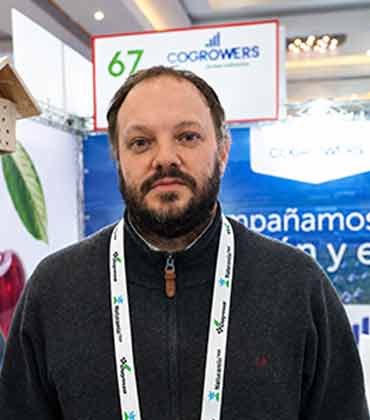 Matas Navarrete, CEO and Founder
“We don’t just collect data; we translate it into concrete, actionable decisions,” says Matas Navarrete, CEO and Founder.
That approach runs through Agroclimate, its IoT-based agroclimatic monitoring platform. Sensors placed across orchards and fields capture real-time data on key variables, including temperature, cold hours, cold portions, growing degree days and bloom or pollination conditions. The data streams to an online platform where growers can track conditions across seasons and compare them across sectors while receiving threshold-based alerts through WhatsApp and phone calls when conditions require attention.
The information reduces the need for constant field checking and removes guesswork from decisions around frost protection, dormancy-breaker timing and irrigation planning. Rather than working from limited on-the-ground visibility or reacting after conditions change, growers can anticipate risk and act preventively, helping protect yield and reduce unnecessary costs.
From Monitoring to Agronomic Action
Cogrowers focuses on translating measurements into decisions rather than leaving growers to interpret generic weather data. Its models are built around agronomic questions such as frost risk and bloom timing. Hour-by-hour temperature variation feeds predictive models that can warn of frost before it materializes, helping growers act fast.
In 99 percent of cases, the platform has accurately informed growers of temperature drops in time to respond. Clients using it for frost control have reduced fuel consumption by an average of 35 percent and cut wind-machine running hours by 25 percent by running the equipment only when it’s needed.
The same data supports decisions beyond frost events. Growers can use season-over-season visibility into cold hours, growing degree days and pollination to time dormancy-breaker applications more precisely and inform irrigation planning. Clients including Dole, Unifrutti, Garcés Fruit, Gesex and CyL Fruit have used Agroclimate to improve these decisions.
-
We don’t just collect data; we translate it into concrete, actionable decisions.
Its Vintec service extends the real-time approach into harvest logistics. Cogrowers works with wineries including Viña Santa Rita and Viña San Pedro, providing information that helps reduce transport times and keep wineries working at maximum capacity during harvest periods.
Flexible Enough for Different Farms
Agricultural conditions vary by crop, orchard sector and climate zone, and Cogrowers configures its sensor network and agronomic models accordingly. This allows the same platform to serve an independent grower or a large company managing fields under very different conditions. Its accessible model brings a level of precision agriculture once beyond the reach of many smaller producers to growers across farm sizes.
Cogrowers is designed to complement, not replace, the infrastructure growers already have. It integrates with third-party systems through APIs, letting agroclimatic data flow into the tools and workflows growers already use. That lets farms adopt precision agriculture incrementally without replacing working equipment, moving into a closed system or undertaking a costly infrastructure overhaul.
Cogrowers operates throughout Chile and has pilot projects underway in Argentina. Its customers range from mid-sized independent producers to some of Chile’s largest agricultural and wine-producing companies, giving it experience across varied crops, climates and production scales.
Toward More Predictive Farm Management
The company has offered automatic threshold-based alerts for several years, giving its move toward predictive agriculture an established base. It continues refining these models while investing in new developments across IoT, AI and data analytics to make decisions earlier and more precise.
The aim is not constant intervention but better timing. By combining real-time field data, crop-specific agronomic logic and increasingly predictive tools, Cogrowers helps growers protect yield, reduce unnecessary resource use and act when field conditions actually call for it. That approach has earned it recognition as a Top Agricultural Production IoT Solution in Latin America 2026.
Turning Field Data into Timely Crop Decisions
A frost alert that arrives after temperatures have crossed a critical threshold turns an IoT investment into little more than a historical record. Meanwhile, agricultural production systems face the harder problem of converting field conditions into decisions early enough to change what happens next. Climate variability has made that timing less forgiving: temperature can shift sharply across blocks, cold accumulation can diverge within the same growing region, bloom conditions can vary across orchard sectors, and harvest windows can compress before managers have a complete picture of field conditions.
Buying decisions should begin with the usefulness of field-level data rather than the number of sensors offered. A system must capture conditions where management decisions are actually made and present readings in a form that reflects crop differences. Broad weather data can miss meaningful variation between orchard sectors, while excessive device density raises cost without guaranteeing better judgment. Beyond coverage, configuration matters just as much. Temperature thresholds, cold accumulation models, growing degree days, and pollination conditions do not carry the same meaning across every crop or climate zone. Growers need enough spatial detail to expose material differences, plus historical visibility that shows how conditions develop from one season to the next. That combination makes comparison more useful than a stream of isolated measurements.
Timing carries equal weight. Dashboards that require constant checking simply move the monitoring burden from the field to a screen. Alerts should be tied to agronomic thresholds and reach responsible personnel through channels already used during frost events or other time-sensitive periods. Predictive functions deserve scrutiny as well: a forecast has practical value when its logic connects to a specific production decision and gives managers enough lead time to act without creating repeated false alarms. Buyers should also examine whether the system turns temperature movement into guidance that can be acted on directly rather than leaving agronomy teams to interpret raw readings during narrow decision windows.
“Cogrowers’ Agroclimate platform links field sensors to real-time agroclimatic monitoring and threshold alerts delivered through WhatsApp and phone calls, reducing the need for constant platform checks.”
Integration often determines whether adoption stays focused or expands into an infrastructure project. Many farms already have weather stations, irrigation equipment, management software and field sensors. Replacing those assets to add a monitoring layer can weaken the economics of an otherwise useful purchase. API connectivity and compatibility with established workflows reduce that friction, particularly for producers adding precision tools gradually. Data should move into systems already used by farm staff instead of remaining trapped in another closed interface. Deployment should also scale without forcing smaller growers into the architecture designed for large estates. The more a platform can work around existing equipment and established routines, the easier it is to judge the technology on decision quality rather than migration effort.
Among agricultural production IoT options, Cogrowers stands out for growers who need climate-driven decisions without replacing existing farm technology. Its Agroclimate platform links field sensors to real-time agroclimatic monitoring and threshold alerts delivered through WhatsApp and phone calls, reducing the need for constant platform checks. Predictive models based on hour-by-hour temperature variation add an earlier frost warning. The platform can be configured by crop and orchard sector, while API integration lets data enter existing tools. For frost management, users have reported 35 percent lower fuel consumption and 25 percent fewer wind-machine operating hours, giving buyers a concrete efficiency case alongside earlier risk detection.
...Read more
Company
Cogrowers
Management
Matas Navarrete, CEO and Founder
Description
Cogrowers is a Chilean agtech company delivering real-time agroclimatic intelligence through its IoT-based Agroclimate platform. It helps growers monitor field conditions, anticipate frost risk, optimize decisions and integrate precision agriculture into existing systems while reducing unnecessary resource use and costs.
