
Thank you for Subscribing to Agri Business Review Weekly Brief


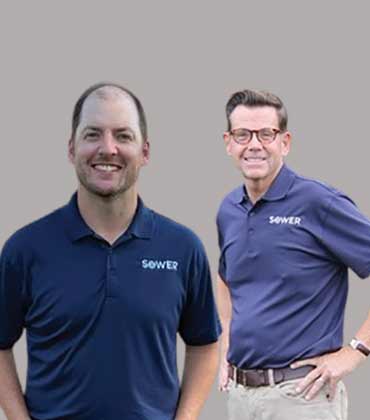 Ethan Branscum, Director of Investments and Chris Chard, Managing Director
America’s farmland is entering a generational ownership transition. According to the USDA, about 70 percent of U.S. farmland is expected to change hands over the next 20 years, driven by the aging farming population. This creates a need for ways to change ownership while allowing farming families to continue farming. At the same time, investors are seeking diversification through assets with relatively lower volatility than stocks and not correlated to stocks and bonds.
Sower Farmland operates at that intersection
It acquires investment-grade row-crop farmland from farming families through sale-leasebacks, typically at a discount, and then leases the land back to the families, their heirs or other operators. This gives landowners liquidity, keeps the land productive and provides investors with exposure to farmland without directly owning or managing individual properties.
Sower’s evergreen private fund reinforces its long-term approach. Unlike a closed fund that may eventually need to liquidate its holdings, the structure enables the company to continue owning and leasing the land without a predetermined exit. For farmers who sell land through a sale-leaseback, the evergreen fund enables them to continue operating the property without facing a fund-driven sale later.
“We knew there was a pipeline of opportunities to buy and manage these farms, and an evergreen private fund was the best vehicle for diversification,” says Chris Chard, managing director.
Turning Local Relationships into Opportunities
Sower’s relationships with farmers create opportunities for operators to expand without purchasing additional land. As sellers may continue farming the property after a sale-leaseback, the company’s reputation for treating landowners fairly is key to building the trust that supports these transactions.
Existing operators can also approach Sower when neighboring farmland comes up for sale. It refers to these acquisitions as bolt-ons, where an existing farm can become the starting point for acquiring neighboring farmlands. The approach also enables access to off-market opportunities. About half of farmland transactions never become listed properties, creating opportunities for Sower to identify farms through its local relationships.
-
We knew there was a pipeline of opportunities to buy and manage these farms, and an evergreen private fund was the best vehicle for diversification.
Sower evaluates potential acquisitions around the characteristics it considers fundamental to investment-grade row-crop farmland, particularly strong soil quality and reliable water availability through rainfall or irrigation. Its portfolio spans more than seven states, with much of it concentrated across the Corn Belt, including Nebraska, Iowa and Illinois. The company also sees opportunity in smaller investment-grade farms that may fall below the transaction sizes sought by larger institutional buyers.
As a landlord rather than an operator, Sower is less directly exposed than the farmer to commodity-price and operating pressures. If an operator exits, neighboring farmers can provide another potential source of demand for the land. Its value-creation model combines acquiring land at a discount with lease income, appreciation and improvements to the underlying assets.
Portfolio Diversification without Direct Ownership
For investors, Sower positions annual-crop farmland as a diversification opportunity that is a strong complement to other investments like stocks, bonds and real estate. Its relatively low volatility and return potential can make the asset particularly relevant to investors approaching retirement. The company works with wealth managers to demonstrate how farmland can complement an existing portfolio by potentially reducing overall risk and adding a source of income.
The private fund structure allows investors to gain exposure to a portfolio of row-crop farms while Sower handles the acquisition and management of the underlying properties.
The fund is available to accredited investors through custodial platforms including Fidelity, Schwab and Pershing, with investments starting at $50,000.
Sower’s recognition as the Top Agricultural Land Investment Solution 2026 reflects a model built around more than farmland ownership. By combining sale-leasebacks, relationship-driven sourcing and evergreen ownership, it connects investors to a finite asset whose long-term supply is constrained as productive farmland leaves agriculture for development and other uses.
Farmland Value Starts at the Entry Price
A farmland can look deceptively simple from a portfolio perspective. The asset is tangible, and lease income is familiar. Long-term land appreciation is also easy to understand. The harder buying question is whether an investment manager can consistently acquire productive acreage on terms that protect returns before ownership begins.
Competition for high-quality row crop ground can push pricing beyond the point where rental income and appreciation justify the entry cost. Scarcity by itself does not rescue an overpriced purchase. For executives evaluating farmland investment solutions, sourcing discipline matters as much as the asset itself.
The transfer of agricultural land between generations is enlarging the opportunity set, but it is not creating uniform value. Many family-owned farms come to market because of retirement planning or estate transitions, while institutional buyers often prefer transactions large enough to justify their acquisition process. That leaves a meaningful middle market where pricing can depend heavily on local relationships and transaction structure.
A manager that relies mainly on broadly marketed listings may face tighter pricing and less control over deal quality. Access to off-market opportunities can change the economics before any improvement work begins. It can also preserve continuity when a family wants liquidity without immediately changing who farms the property.
Asset selection also needs to distinguish farmland ownership risk from farming risk. Commodity prices can pressure farm operators, yet a landlord’s exposure is shaped more directly by lease terms and the depth of local farming demand. Productive soil and dependable water remain central because they support tenant interest through weaker commodity cycles. Geographic diversification can reduce concentration, but spreading capital across acreage without understanding local crop economics can dilute rather than improve portfolio quality.
Buyers should look for evidence that expansion follows repeatable land standards rather than a desire to add acres. Nearby acquisitions may be especially attractive when existing tenants can farm additional ground without materially changing their equipment footprint.
Fund structure introduces another tradeoff. A farmland is inherently illiquid, and forcing liquidity onto the asset can create tension between investor redemption expectations and the timing of farm sales. Closed-end vehicles create a different issue when an exit timetable requires assets to be sold regardless of tenant continuity or local market conditions.
An evergreen structure can better match the long holding periods associated with farmland, provided investors understand the liquidity limits before committing capital. Governance around valuation and lease management, therefore, deserves close review because reported stability should reflect the property base rather than an artificially smooth presentation. Investors should also test whether the manager’s holding period supports the acquisition thesis instead of dictating it.
Sower Farmland is a premier choice for accredited investors who prioritize disciplined acquisition over broad farmland exposure. Its model centers on buying investment-grade annual crop farmland at a discount, often through sale-leaseback transactions that let farm operators remain on the land. Its portfolio is concentrated in row crop farmland across multiple states, with soil quality and water access guiding purchases.
Sower Farmland’s evergreen fund structure is designed to avoid forced asset sales tied to a fixed fund life. Local farmer relationships also create opportunities to add nearby acreage when off-market properties become available. That combination aligns well with buyers who want farmland exposure built around entry price and long holding periods.
...Read more
Company
Sower Farmland
Management
Ethan Branscum, Director of Investments and Chris Chard, Managing Director
Description
Sower Farmland acquires investment-quality farmland through sale-leasebacks, allowing farmers to retain operational control while providing investors access to farmland through its private fund. Its model connects transitioning farm families, local operators and investors around long-term farmland ownership.
