
Thank you for Subscribing to Agri Business Review Weekly Brief


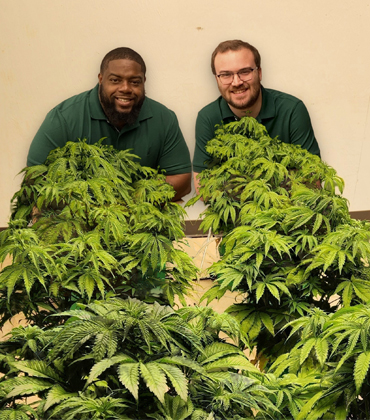 Christian Taylor, Founder & CEO and Ryan Laurent, COO
Closed Cultivation Technology (CCT) reverses that equation. By combining modular hardware with intelligent environmental controls and AI integration, it delivers an autonomous cultivation system designed to make diverse fresh food production possible wherever it is needed, with minimal human intervention.
“Our systems are designed to grow crops while you sleep, running themselves without constant observation,” says Christian Taylor, CEO and CTO.
Growing up in rural Mississippi, Taylor witnessed how limited crop diversity and supply chain constraints shaped local agriculture. An African American veteran, he developed a passion for hardware and engineering during his military service. The result was CCT, created to make fresh food production more accessible, reliable and geographically unrestricted.
One System for Diverse Crop Production
CCT sees autonomous cultivation as a way to remove geography as a barrier to fresh food, with systems that adapt to growers rather than forcing them to produce a single crop. Its three modular hardware products—the MGU for microgreens and herbs, the NLC for vine crops and hemp and the SCM for nutrient delivery and consistent fresh water—create a unified platform that is flexible and easy to use.
Built around the principle of growing while people sleep, the ecosystem self-monitors and self-manages crop conditions, reducing the need for constant field inspections or drone monitoring. Environmental controls are also designed to reduce reliance on additional pesticides.
-
Our systems are designed to grow crops while you sleep, running themselves without constant observation.
Continuous monitoring of electricity, water and nutrient use improves resource efficiency. Smart management controllers capture, filter and return water to the system used by NLCs and MGU. Component-level power tracking and adjustable lighting further improve energy efficiency and reduce costs.
CCT is also integrating AI to analyze operational data and cultivation patterns, helping optimize decisions. Capabilities under development include identifying nutrient deficiencies and chemical burn, recommending corrective actions and adjusting growing parameters to reduce manual diagnosis.
In one instance, a hemp grower sought higher yields with lower power use. CCT optimized nutrient management through its control system without changing the chemicals used. Within the same footprint, the operation achieved higher potency, nearly double the yield and lower power consumption through its NLC system, along with minimized chemical burn.
Putting Ownership Back in Growers’ Hands
CCT’s customer philosophy centers on ownership instead of subscription-driven lock-ins. Growers retain their hardware, crops and the value they create, allowing more of their agricultural profits to remain with them. Throughout deployment, they receive onboarding and operational support.
“Our goal is to make farming profitable for farmers, enabling them to scale, diversify and grow the crops they want within their confined space,” says Ryan Laurent, COO.
The platform supports experienced commercial growers and newcomers, combining sophisticated automation with straightforward operation. Easy-to-read, step-by-step guidance is integrated into the management system, allowing growers to diagnose and resolve issues with a click while encouraging a ‘you own it, you can repair it’ mindset. This support model helps maintain uptime and consistent output quality.
CCT’s customer-centric approach is underpinned by Laurent and Taylor’s complementary experience. Laurent’s background in finance, banking and real estate, combined with Taylor’s product development expertise, shapes CCT’s technical and commercial perspective. The pair continually advances the platform at its testing facility through new hardware and software development.
Looking ahead, CCT aims to shorten transportation distances, reduce reliance on chemical inputs and give growers greater resilience against supply chain disruptions.
By delivering a cultivation system designed to run with minimal human intervention, CCT enables producers to diversify crops and support greater profitability. It envisions a future where even a child living in a desert can taste a fresh, locally produced strawberry.
Closed Cultivation Systems for Predictable Crop Production
Agriculture executives are being asked to solve a contradiction that traditional production models rarely handle well—grow more consistent crops while reducing dependence on labor, water, chemicals and geography.
Field agriculture still carries value, but it leaves management teams exposed to weather shifts, pest pressure, land constraints, transport distance and input volatility. Greenhouse and vertical models have improved control, yet many remain tied to narrow crop profiles, heavy monitoring requirements or complex service arrangements that make adoption harder for growers who need practical returns rather than experimental technology. Executives also need systems that fit real farms, not pilot rooms, because capital plans depend on predictable ramp-up and serviceable equipment.
A gold standard closed cultivation smart farming system should reduce uncertainty inside the growing environment. Sensors and automation are useful only when they move beyond data display and support timely action. Executives should look for systems that monitor crop health, nutrient balance, water use, lighting, airflow and energy draw in a connected manner, then help correct deviations before they become yield losses. The value is not simply fewer manual checks. It is the ability to make growing conditions more repeatable across cycles, locations and crop types.
Flexibility is equally important. Many controlled growing systems are designed around a narrow crop model, which can lock growers into a limited revenue path. A stronger approach allows producers to work across different plant sizes, growth habits and market needs without rebuilding the entire environment. That matters for operators managing demand shifts across microgreens, herbs, berries, hemp or specialty crops. Crop diversity is also a business safeguard. It helps growers avoid overdependence on one product and gives local markets access to fresher produce without long transport chains.
Resource discipline must also be central to the decision. Water recapture, targeted nutrient delivery, power monitoring and lighting schedules affect both margin and environmental impact. These systems should make resource use visible enough for management teams to understand cost drivers, tune production schedules, and improve output without relying on guesswork. The strongest solutions also reduce the need for large crews inside the grow space, not by removing human judgment, but by reserving it for supervision, planning and exceptions.
Ownership and support deserve close attention. Growers should not be trapped in a model where hardware feels inaccessible, repairs require replacement of entire units, or software adds cost without improving day-to-day control. A practical system should make setup, troubleshooting, part replacement and ongoing learning manageable for growers with different levels of technical experience. The better long-term fit is a platform that lets the producer own the equipment, understand the process and scale without losing control of margins.
CCT is the premier choice for executives evaluating closed cultivation smart farming because its system aligns closely with these needs. Its NLCs, MGU and STM products form a unified hardware platform for taller vine crops, microgreens, hemp, berries, nutrient delivery, water consistency and environmental control.
Its self-managed design uses Agentic AI to read sensors, make adjustments and forecast yields, while its crop-specific platforms support microgreens, berries and hemp. CCT is best suited for buyers who want owned hardware, flexible crop production, lower resource waste and a system designed to grow with limited intervention.
...Read more
Company
Closed Cultivation Technology (CCT)
Management
Christian Taylor, Founder & CEO and Ryan Laurent, COO
Description
Closed Cultivation Technology develops autonomous smart farming systems that simplify multi-crop production through AI-driven automation and intelligent environmental controls. Its self-managing platform helps growers improve profitability, optimize resources and expand fresh food production beyond traditional geographic limitations.
